
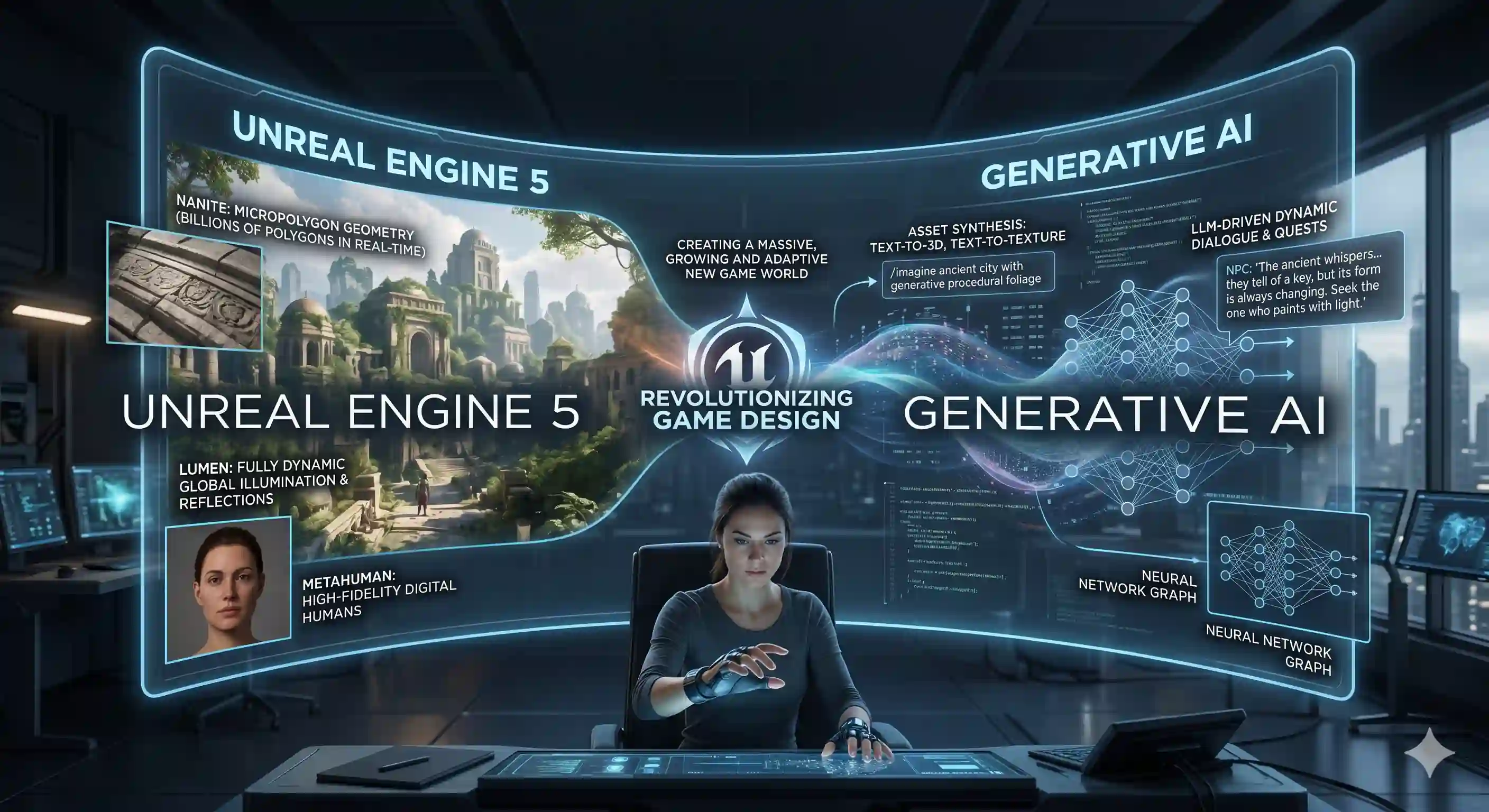
The real-time 3D entertainment industry is experiencing a generational leap driven by two monumental technologies: Epic Games' Unreal Engine 5 (UE5) and Generative AI procedural workflows. For 3D artists, game developers, and technical artists in Bangalore, mastering these systems is the definitive gateway to modern AAA game production and virtual filmmaking.
- 1. Nanite Virtualized Geometry: The End of LODs and Poly-Count Bottlenecks
- 2. Lumen Global Illumination: Fully Dynamic Real-Time Lighting
- 3. Procedural Content Generation (PCG): Building Vast Worlds with Node Logic
- 4. MetaHuman Creator & AI Facial Rigging
- 5. Generative AI in the Production Pipeline: Assistive, Not Autonomous
- 6. Unreal Engine Blueprints vs C++: Empowering Artists to Code
- Nanite virtualized micropolygon geometry eliminates manual LOD creation and normal map baking for hero assets.
- Lumen delivers fully dynamic global illumination and infinite bounce reflections in real time without baked lightmaps.
- Procedural Content Generation (PCG) framework allows artists to populate sprawling biomes using rule-based node graphs.
- MetaHuman Creator and AI-assisted facial rigging generate film-ready digital humans in minutes instead of months.
- Generative AI tools (Midjourney, Adobe Firefly, Runway ML) accelerate concept art, PBR textures, and preliminary animation blocking.
1. Nanite Virtualized Geometry: The End of LODs and Poly-Count Bottlenecks
Before Unreal Engine 5, 3D game artists spent up to 50% of their production time creating Level of Detail (LOD) models, retopologizing cinematic sculpts down to low-poly meshes, and baking normal maps in xNormal or Substance. Nanite fundamentally altered this paradigm by virtualizing micropolygon geometry directly on the GPU.
With Nanite enabled, artists can import multimillion-polygon ZBrush sculpts, photogrammetry terrain scans, and CAD data directly into Unreal Engine without performance drops. Nanite dynamically scales detail on a per-pixel basis: only polygons that occupy visible pixels on screen are drawn. This frees technical artists from tedious polygon budgets, allowing them to focus on artistic silhouette, micro-surface realism, and world atmosphere.
2. Lumen Global Illumination: Fully Dynamic Real-Time Lighting
Traditional game lighting required hours of baking indirect lighting into lightmap textures. Any change to environment geometry or sun angle meant re-baking the entire level. Lumen replaces static lightmaps with a hybrid software-hardware ray tracing system that recalculates indirect diffuse bounce, emissive material glow, and specular reflections in real time at 60+ FPS.
In UE5.4+, Lumen handles massive dynamic environments with moving sun angles, destroyed architecture, and real-time flashlight shadows effortlessly. Level lighting artists at MAAC Jayanagar's production labs can iterate on cinematic mood boards and day-to-night transitions instantly without waiting for render farms.
ADIDG Plus — Interactive Design & Game Art
Comprehensive career program with hands-on studio showreel production and placement support at MAAC Jayanagar, Bengaluru.
3. Procedural Content Generation (PCG): Building Vast Worlds with Node Logic
Hand-placing millions of trees, rocks, debris props, and foliage across open-world game maps is no longer viable for modern development schedules. Unreal Engine's Procedural Content Generation (PCG) framework allows level designers to construct interactive node graphs that define environmental rules.
- Biomes and Terrain Sampling: Automatically spawn forest density, moss, and riverbed pebbles based on landscape slope, elevation, and biome masks.
- Dynamic Spline Scattering: Draw a road or river path, and PCG automatically clears trees, spawns gravel borders, and places guardrails alongside the spline.
- Interactive Gameplay Bounds: Connect PCG rules to gameplay triggers so environments dynamically alter during boss encounters or seasonal events.
4. MetaHuman Creator & AI Facial Rigging
Creating believable digital humans used to require dedicated scanning rigs, weeks of blendshape sculpting, and complex facial skeleton setups. Epic Games' MetaHuman Creator combines cloud-based parametric sculpting with machine-learning facial landmark tracking to deliver photorealistic characters equipped with complete facial rigs, hair grooming (Strand-based grooming), and LODs within minutes.
Coupled with Live Link Face on mobile devices and AI motion tracking via Cascadeur, student animators can drive nuanced real-time facial expressions directly onto hero game characters inside UE5.
5. Generative AI in the Production Pipeline: Assistive, Not Autonomous
Studios in 2026 treat Generative AI as a turbocharger for artist creativity rather than an autonomous replacement. The current production workflow integrates AI at specific pipeline bottlenecks:
- Concept Art & World Mood: Midjourney and Leonardo AI generate rapid silhouette studies and environmental color palettes in under 30 minutes.
- PBR Material Synthesis: Adobe Firefly and Substance 3D Sampler convert text prompts and photos into seamless, tileable PBR normal, roughness, and height maps.
- AI Animation Assistance: Cascadeur uses physics-informed AI to calculate natural center of mass, angular momentum, and foot planting for keyframe animators.
- Code Assistance via Blueprints: AI coding assistants provide real-time logic node suggestions for Unreal Engine Blueprints visual scripting.
6. Unreal Engine Blueprints vs C++: Empowering Artists to Code
One of Unreal Engine's greatest strengths is Blueprint visual scripting. Designers and artists without traditional computer science degrees can build complex interactive mechanics, character controllers, enemy AI behavior trees, inventory systems, and UI widgets entirely through interconnected visual nodes. For aspiring technical designers, Blueprints provide an intuitive, visual gateway to game logic before transitioning to native C++.
Master Unreal Engine 5 & AI Game Art at MAAC Jayanagar
Explore CoursesWhat hardware is required to run Unreal Engine 5 smoothly for game design?
UE5 requires a multi-core processor (Intel Core i7/i9 13th+ Gen or AMD Ryzen 7/9), minimum 32GB DDR5 RAM, and a dedicated NVIDIA RTX GPU (RTX 3070, 4070, or higher with 8GB+ VRAM) to leverage Nanite, Lumen hardware ray tracing, and real-time viewport baking. At MAAC Jayanagar, students practice on enterprise RTX workstations configured specifically for heavy real-time engine loads.
Can I learn Unreal Engine 5 without prior coding experience?
Yes. Unreal Engine's Blueprints Visual Scripting system enables artists to create fully functional gameplay mechanics, interactive triggers, character abilities, and user interfaces without writing a single line of C++ code. MAAC Jayanagar's game design curriculum teaches Blueprints from the absolute ground up.
How does MAAC Jayanagar incorporate Generative AI into game design training?
Our curriculum integrates AI tools into professional workflows: Midjourney and Leonardo AI for rapid environment concepting, Substance 3D AI filters for procedural texture maps, and MetaHuman for real-time digital character pipelines. Students learn to use AI as an efficiency tool while maintaining total artistic control over game mechanics, topology, and art direction.