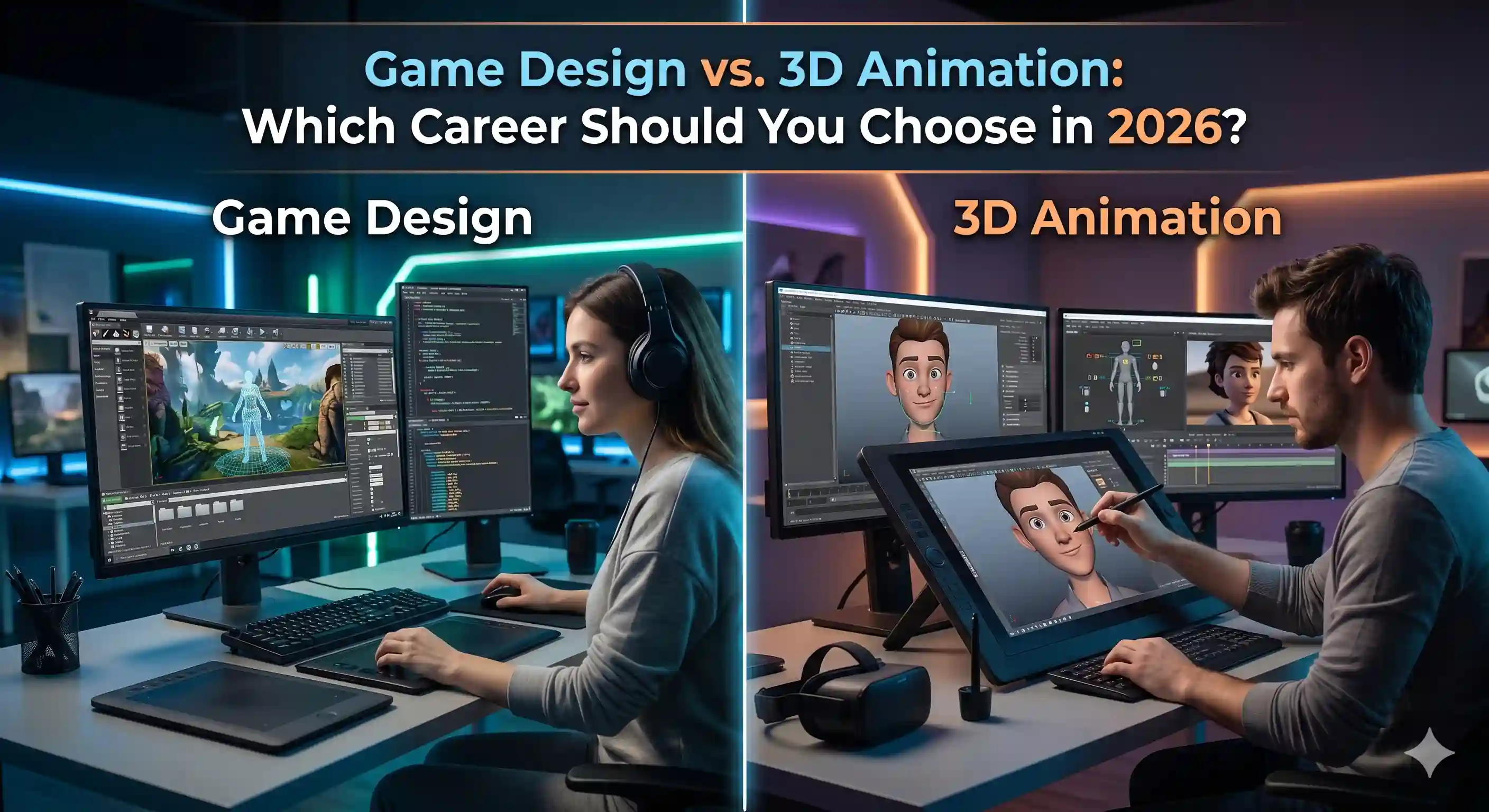
- Two Sides of the Same Digital Coin
- What Does a 3D Animator Actually Do?
- What Does a Game Designer Do?
- Salary and Growth in Bangalore
- The Physics of Performance: Weight, Balance & Biomechanics
- Core Animation Software Stack & Pipeline Mastery
- 2026 Industry Hiring Trends & Salary Benchmark in India
- 1. 2026 Industry Landscape & Studio Hiring Requirements
- 2. Production Pipelines, Software Tools & Workflow Masterclass
- 3. Salary Expectations, Career Growth & Studio Placements in India
- 4. Why Artificial Intelligence Cannot Replace Human Creative Vision
Two Sides of the Same Digital Coin
- Game designers create rules, systems, and player experiences; 3D animators bring characters to life.
- Both fields use Maya, Blender, and ZBrush — but game design also requires Unreal Engine and Unity.
- Salaries are comparable: game designers Rs. 3.5–12 LPA; 3D animators Rs. 3–10 LPA in India.
- MAAC Jayanagar offers dedicated programs for both — ADIDG Plus for games, AD3D EDGE Plus for animation.
Many students walk into the MAAC Jayanagar campus knowing they want to build digital worlds, but they are stuck at a crossroads: Should I pursue Game Design or 3D Animation? While these two fields share a lot of the same software (like Maya and Unreal Engine), the day-to-day workflow and final outputs are completely different.
Undecided Between Game Design & 3D Animation?
Take our free creative aptitude counseling session at MAAC Jayanagar to find the exact track that matches your strengths.
Book Free Counseling Session →A practical decision guide to help students choose between Game Design and 3D Animation based on their skills, interests, and career goals.
- Assess Your Core Interests
If you love playing games, designing systems and player mechanics, choose Game Design. If you're drawn to storytelling, character performance, and film, choose 3D Animation.
- Try Both with Free Tools
Download Blender (free) and try character animation for 2 weeks. Then download Unreal Engine 5 (free) and try building a simple level. Your natural preference will become clear quickly.
- Research the Job Market
Look up current openings on LinkedIn for 'Game Designer Bangalore' and '3D Animator Bangalore'. Review what software is required and the salary ranges being offered.
- Choose a Program and Specialise
Enroll in MAAC Jayanagar's ADIDG Plus for Game Design (UE5, Unity, Maya) or AD3D EDGE Plus for 3D Animation (Maya, ZBrush, Houdini). Both are 602-hour professional programs with placement support.
- Build Your Portfolio Immediately
Start building portfolio pieces from Day 1 of your course. For animation: a 3D character acting shot. For game design: a playable level or game prototype in UE5.
What Does a 3D Animator Actually Do?
A 3D Animator focuses entirely on performance and movement. They take a pre-built 3D model and give it life. Whether it is a subtle facial expression for a movie character or a complex fight sequence, animators are digital actors. Their work is linear—meaning it is meant to be watched from start to finish exactly as the director intended.
- Core Software: Autodesk Maya, Blender, ZBrush.
- Best for you if: You love storytelling, have a great sense of timing, and enjoy focusing deeply on the artistic performance of a character.
ADIDG Plus — Interactive Design & Game Art
Comprehensive career program with hands-on studio showreel production and placement support at MAAC Jayanagar, Bengaluru.
What Does a Game Designer Do?
A Game Designer focuses on interactivity and systems. They don't just worry about how something looks; they worry about how it plays. A game designer creates the rules, the level layouts, the player mechanics, and ensures the game is actually fun to experience. Their work is non-linear, because every player will interact with the game differently.
- Core Software: Unreal Engine 5, Unity, C# / C++ (basics), Maya.
- Best for you if: You are highly analytical, enjoy solving puzzles, and want to create interactive experiences rather than just passive movies.
Salary and Growth in Bangalore
In 2026, both fields offer excellent starting salaries in India, typically ranging from ₹3.5L to ₹5.5L for freshers. However, due to the massive global boom in the gaming industry, Game Designers and Technical Animators (who combine both skill sets) often see a slightly faster salary trajectory in tech-heavy hubs like Bengaluru. Ultimately, the best choice depends entirely on how your brain works: are you a storyteller or a system builder?
The Physics of Performance: Weight, Balance & Biomechanics
Human locomotion and character acting are governed by complex biomechanical physics. When a character walks, runs, or expresses emotion, every joint, muscle, and center of gravity shift must align with the character's internal thoughts and external physical resistance. Animators spend years studying live-action reference, body mechanics, and acting techniques to bring digital characters to life. Generative AI video generators lack physical weight understanding, producing floaty movement that immediately breaks audience immersion.
Core Animation Software Stack & Pipeline Mastery
- Autodesk Maya: The undisputed global standard for 3D character rigging, keyframe animation, and muscle deformation
- Blender: Open-source 3D suite for rapid previz, character layout, and Grease Pencil hybrid 2D/3D animation
- ZBrush: High-definition digital sculpting for character concept design and blendshape creation
- Unreal Engine 5 Control Rig: Real-time character animation, virtual production, and interactive cinematic performance
- Toon Boom Harmony: Professional 2D character animation and cut-out rigging for broadcast series
2026 Industry Hiring Trends & Salary Benchmark in India
With the global explosion of OTT streaming platforms, animated feature films, and AAA game production, trained 3D Animators enjoy immense job security. Salaries in India start at ₹4 LPA to ₹6 LPA for junior animators, scaling up to ₹15 LPA to ₹30+ LPA for senior character animators and animation directors. Artists who understand performance acting and narrative pacing remain the most sought-after talent in the industry.
1. 2026 Industry Landscape & Studio Hiring Requirements
The media, entertainment, and digital technology sectors across India and global markets are undergoing an extraordinary transformation in 2026. As streaming giants like Netflix, Amazon Prime Video, Disney+ Hotstar, and Apple TV+ increase their investments in Indian original content, studio requirements for high-end digital artists have evolved dramatically. Studios no longer look for entry-level technicians who merely press buttons in software interfaces. Today's animation studios, visual effects facilities, and game development houses demand creative problem solvers who possess deep artistic fundamentals—including composition, color theory, physical weight mechanics, lighting contrast, and visual storytelling.
According to the latest 2026 AVGC-XR (Animation, Visual Effects, Gaming, Comics and Extended Reality) Industry Benchmark Report, the Indian creative economy is growing at a compound annual growth rate (CAGR) of 18.5%. Cities like Bengaluru, Mumbai, Hyderabad, and Pune have solidified their position as global production hubs for Hollywood blockbusters, AAA video game titles, and international commercial broadcasts. For aspiring artists entering the industry in 2026, gaining comprehensive production training that bridges traditional artistic discipline with cutting-edge digital pipelines is the single most critical factor determining career success.
2. Production Pipelines, Software Tools & Workflow Masterclass
Modern production environments operate on highly integrated software pipelines where multi-disciplinary collaboration is essential. Whether working on a feature-length 3D animated movie, a visual-effects-heavy sci-fi series, or a real-time game engine environment, artists utilize an ecosystem of industry-standard tools:
- Autodesk Maya & 3ds Max: The gold standard for 3D character modeling, rigging, layout, lighting, and keyframe animation
- Foundry Nuke X: Industry-leading node-based compositing software used by 95% of Oscar-winning VFX studios worldwide
- Unreal Engine 5.4+: Real-time virtual production, real-time lighting (Lumen), geometry virtualization (Nanite), and game level design
- SideFX Houdini: Procedural volumetric simulation suite for realistic fire, smoke, water, ocean physics, and structural destruction
- Adobe Creative Cloud (Photoshop, Illustrator, After Effects, Premiere Pro): Core visual design, digital matte painting, kinetic motion graphics, and video editing
- ZBrush & Substance 3D Painter: High-definition digital sculpting, PBR material creation, and photorealistic asset texturing
Understanding how these software suites communicate via USD (Universal Scene Description) and multi-channel 32-bit EXR file formats allows artists to work fluidly across teams. At MAAC Jayanagar, students spend over 60% of their course duration inside dedicated studio production labs, simulating real-world client briefs and studio pipeline constraints under the guidance of seasoned industry mentors.
3. Salary Expectations, Career Growth & Studio Placements in India
A career in Animation, VFX, Game Design, or UI/UX product design offers some of the most lucrative and rewarding opportunities in the modern job market. Compensation packages in India scale rapidly based on portfolio quality, technical specialization, and artistic skill:
- Freshers / Junior Artists (0-2 Years): ₹3.8 Lakhs to ₹6.5 Lakhs per annum starting salary
- Mid-Level Specialist Artists (3-5 Years): ₹7.5 Lakhs to ₹14 Lakhs per annum
- Senior Leads, Supervisors & Technical Directors (5-8+ Years): ₹16 Lakhs to ₹35+ Lakhs per annum
- International Remote Freelance & Consultancies: $35 to $90 per hour depending on portfolio prestige
Top studio recruiters—including DNEG, Technicolor Creative Studios, Rockstar Games India, Ubisoft, PhantomFX, Red Chillies VFX, and Framestore—regularly conduct campus placements at MAAC Jayanagar. Students who build a strong, unique showreel showcasing individual artistic voice combined with technical mastery consistently secure immediate job offers upon course completion.
4. Why Artificial Intelligence Cannot Replace Human Creative Vision
While generative AI tools can automate repetitive prep tasks like basic rotoscoping or initial asset blocking, they lack human emotion, intent, and artistic taste. AI models operate by calculating statistical mathematical averages of pre-existing training data. Consequently, AI outputs frequently suffer from visual clichés, lack of shot-to-shot temporal continuity, and an inability to adapt to highly specific director feedback.
Filmmaking, game development, and design are fundamentally human collaborative endeavors. A director does not hire an artist to generate a generic computer average; they hire an artist for their unique human vulnerability, emotional subtext, and creative problem-solving. Artists who embrace AI as a productivity tool alongside core software pipelines are finishing projects faster and positioning themselves at the absolute top of the industry hierarchy.
Which pays higher: Game Design or 3D Animation?
Both fields offer comparable salaries in India. Game designers with Unreal Engine 5 expertise earn Rs. 3.5–12 LPA, while 3D animators for film and OTT earn Rs. 3–10 LPA. Senior game designers at major studios often earn more due to longer pipelines and technical complexity. The key factor is your specialization, portfolio quality, and the type of studio you target.
Can I learn both Animation and Game Design together?
Yes. MAAC Jayanagar's flagship IPVAD-XR program integrates both Animation and Game Design within a single 3-year B.Voc program, covering Maya character animation and Unreal Engine 5 game development. Students can also combine the AD3D EDGE Plus (animation) with short UE5 modules. Developing skills in both disciplines makes graduates more versatile and employable across studios.
Do I need coding skills for Game Design at MAAC?
No advanced coding is required. MAAC Jayanagar's game design program focuses on Unreal Engine 5's Blueprint visual scripting system, which allows students to create game logic without writing traditional code. Basic C++ concepts are introduced at an advanced level, but the primary emphasis is on visual design, level creation, and game mechanics using node-based tools accessible to non-programmers.