The post-production landscape has shifted dramatically in 2026. The integration of Generative AI tools into standard video editing and visual effects pipelines has empowered solo creators and studio editors to achieve visual fidelity that previously required multi-million-dollar VFX budgets. From text-to-video generation with OpenAI Sora and Runway Gen-3 Alpha to neural voice synthesis via ElevenLabs and custom node graph control in ComfyUI, modern video editors must master hybrid AI-traditional workflows to remain competitive.
- Deep-Dive Technical Analysis: The Science of Multi-Pass Compositing
- Industry Standard Software Stack & Production Pipelines
- Career Trajectory, Salaries & Global Studio Placement in 2026
- 1. 2026 Industry Landscape & Studio Hiring Requirements
- 2. Production Pipelines, Software Tools & Workflow Masterclass
- 3. Salary Expectations, Career Growth & Studio Placements in India
- 4. Why Artificial Intelligence Cannot Replace Human Creative Vision
- AI video tools like Runway ML, CapCut AI, and Adobe Firefly reduce editing time by up to 60%.
- Human creatives remain essential for storytelling, emotional resonance, and client communication.
- Learning AI tools alongside traditional editing gives you a decisive edge in the 2026 job market.
- MAAC Jayanagar integrates Runway ML and AI editing into its VFX and animation programs.
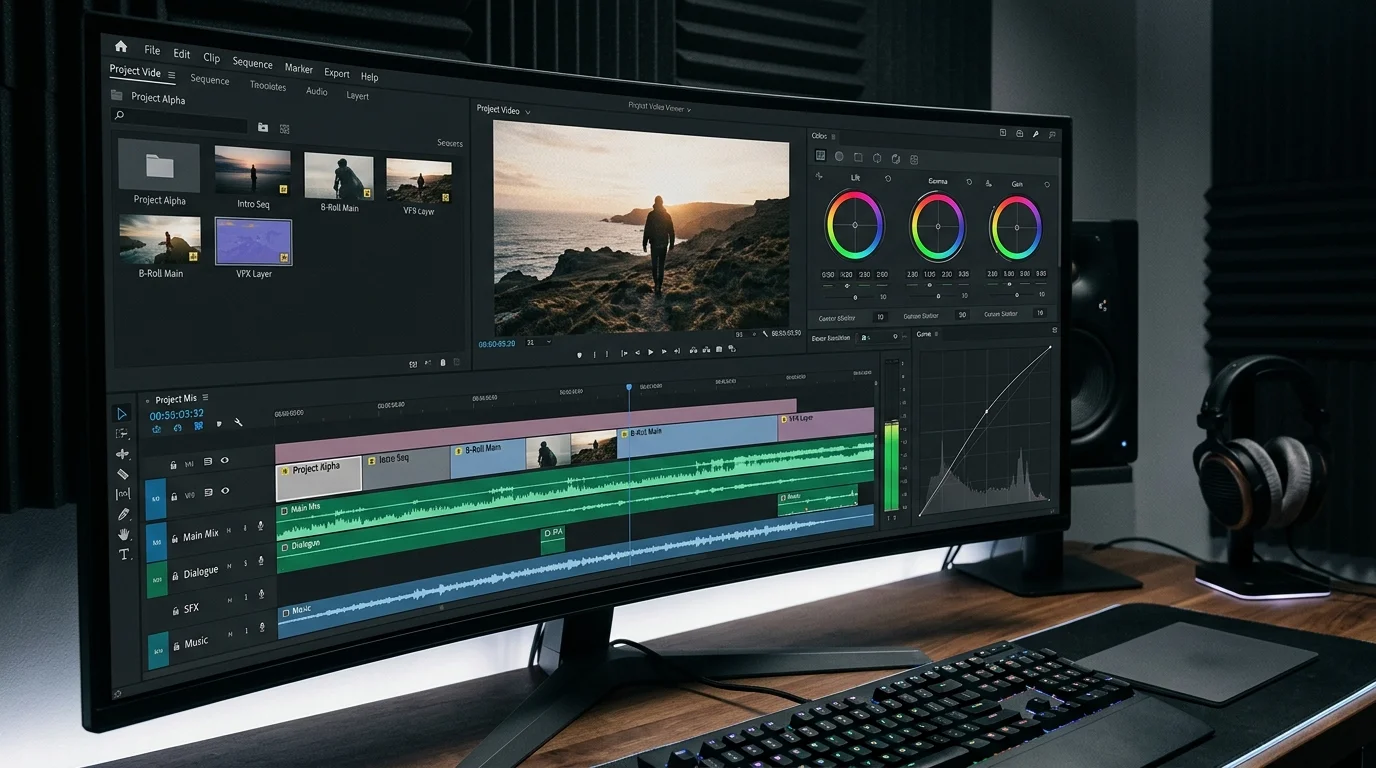
Traditional post-production followed a rigid sequential pipeline: offline rough cut, online finishing, color grading, motion graphics, audio mixing, and final master export. In 2026, AI tools operate non-linearly, enabling real-time previz, generative shot extension, dynamic voice replacement, and automated rotoscoping within standard NLEs (Non-Linear Editors) such as Adobe Premiere Pro, DaVinci Resolve, and Final Cut Pro.
A practical step-by-step guide to integrating AI tools into your professional video editing workflow for faster, higher-quality output.
- Master Your Core NLE First
Get proficient in Adobe Premiere Pro or DaVinci Resolve. AI tools amplify existing skills — they don't replace the need for a strong editing foundation.
- Add AI Scene Detection
Use Adobe Premiere's Auto Reframe, DaVinci's Scene Cut Detection, or Descript for automatic transcription-based editing to speed up rough cut assembly.
- Use AI for B-Roll and Stock Generation
Use Runway ML Gen-2 or Pika Labs to generate B-roll footage from text prompts when you lack footage. Adobe Firefly Video can extend or reframe existing clips.
- Automate Color and Audio Correction
Use DaVinci Resolve's AI Color Match, Magic Mask, and Voice Isolation to dramatically reduce time on color grading and audio cleanup.
- Build a Portfolio Reel
Compile 3–5 polished edited pieces showcasing your AI-enhanced workflow. Include before/after examples to demonstrate the efficiency gains to potential clients or employers.
Navigating the vast ecosystem of AI video utilities requires knowing which software delivers studio-grade reliability versus gimmick tools. Here is the definitive studio tier list:
- OpenAI Sora & Runway Gen-3 Alpha: High-coherence photorealistic text-to-video and video-to-video generation for establishing shots and B-roll replacement.
- ComfyUI & Stable Video Diffusion: Open-source node-based AI generation providing frame-level control over noise schedules, LoRAs, and ControlNets.
- ElevenLabs & Respeecher: Studio-grade neural voice synthesis, AI dubbing in 32 languages, and automated dialogue cleaning.
- Adobe Premiere Pro Generative Extend & Firefly Video: Seamless inline clip padding, object removal, and automated scene edit detection.
- Topaz Video AI 5: Upscaling 1080p archival footage to 4K/8K, motion de-blurring, and 60fps slow-motion frame interpolation.
To achieve seamless broadcast quality without the tell-tale 'AI shimmer' or anatomical distortion, professional post-houses use a hybrid 4-stage pipeline:
Stage 1: Script & AI Pre-Visualization. Editors generate animatics using Midjourney v6 and Runway Gen-3 to establish lighting, camera motion, and timing before cameras roll or 3D assets are rendered.
Stage 2: Core Editing & Assembly. Footage is ingested into DaVinci Resolve or Premiere Pro. AI-assisted text-based editing transcribes audio instantly, allowing editors to cut footage by editing script text.
Stage 3: AI Enhancement & Cleanup. Rotoscoping is automated via Runway Inpainting and Adobe Sensei, saving hundreds of hours of manual pen-tool tracing. Plates are cleaned of wires, mic booms, and unwanted background elements.
Stage 4: Color Grading & Mastering. Neural color match algorithms conform multi-camera setups to target color profiles before human colorists perform final HDR mastering.
Video editors who master Generative AI workflows are commanding premium salaries across advertising agencies, OTT platforms (Netflix, Prime Video), and gaming studios. Below is the current compensation benchmark for AI-trained video specialists in India and globally:
- Junior AI Video Editor (0-2 Yrs): ₹4.5 LPA – ₹7.2 LPA
- Mid-Level Post-Production Lead (3-5 Yrs): ₹8.5 LPA – ₹14 LPA
- Senior AI Technical Director / VFX Supervisor: ₹18 LPA – ₹32+ LPA
At MAAC Jayanagar (Bangalore), we do not treat AI as a replacement for foundational artistry. Our Gen AI for Creators and APDMC Plus programs teach students how to combine core cinematography principles, color theory, and audio engineering with high-speed AI tools. Students graduate with a studio-ready portfolio containing real client case studies and hybrid AI showreels.
Master AI-Powered Video Editing & VFX
Learn Premiere Pro, After Effects, Runway Gen-3, and ComfyUI at MAAC Jayanagar. Get full 2026 syllabus and batch dates.
Get 2026 Editing Syllabus →Deep-Dive Technical Analysis: The Science of Multi-Pass Compositing
Feature film visual effects compositing in Foundry Nuke is an exact mathematical science combined with fine art painting. A master shot consists of dozens of discrete layers: diffuse beauty passes, specular reflection channels, volumetric shadow layers, point-position maps, motion vector data, and 32-bit floating-point Z-depth channels. When a visual effects artist compositing a superhero sequence or sci-fi space battle receives notes from a visual effects supervisor, they manipulate specific mathematical node trees without affecting un-related image data. Generative AI models generate monolithic flattened images that lack discrete channels, rendering them unusable for professional multi-pass film pipelines.
Industry Standard Software Stack & Production Pipelines
- Foundry Nuke X: Industry standard node-based compositing, deep compositing, and 3D camera projection
- SideFX Houdini: Procedural volumetric simulations for fire, smoke, water, ocean dynamics, and rigid-body destruction
- Autodesk Maya: High-end 3D asset modeling, rigging, camera layout, and Arnold/V-Ray rendering
- 3DEqualizer: High-precision 3D camera tracking, lens distortion calibration, and object tracking
- Substance 3D Painter & Photoshop: Photorealistic texturing, digital matte painting, and clean-up
AD3D EDGE Plus — Advanced 3D Animation
Comprehensive career program with hands-on studio showreel production and placement support at MAAC Jayanagar, Bengaluru.
Career Trajectory, Salaries & Global Studio Placement in 2026
The demand for certified VFX artists across India and international studio hubs has reached historic highs. Leading visual effects studios including DNEG, Framestore, Technicolor, Wētā FX, and Red Chillies VFX actively recruit trained compositors, matchmove artists, and Houdini FX TDs. Salary structures in India range from ₹4.5 LPA for entry-level compositors to ₹25+ LPA for senior leads and supervisors. Mastery of industry software combined with AI-assisted prep workflows equips artists to deliver shots faster while commanding top market compensation.
1. 2026 Industry Landscape & Studio Hiring Requirements
The media, entertainment, and digital technology sectors across India and global markets are undergoing an extraordinary transformation in 2026. As streaming giants like Netflix, Amazon Prime Video, Disney+ Hotstar, and Apple TV+ increase their investments in Indian original content, studio requirements for high-end digital artists have evolved dramatically. Studios no longer look for entry-level technicians who merely press buttons in software interfaces. Today's animation studios, visual effects facilities, and game development houses demand creative problem solvers who possess deep artistic fundamentals—including composition, color theory, physical weight mechanics, lighting contrast, and visual storytelling.
According to the latest 2026 AVGC-XR (Animation, Visual Effects, Gaming, Comics and Extended Reality) Industry Benchmark Report, the Indian creative economy is growing at a compound annual growth rate (CAGR) of 18.5%. Cities like Bengaluru, Mumbai, Hyderabad, and Pune have solidified their position as global production hubs for Hollywood blockbusters, AAA video game titles, and international commercial broadcasts. For aspiring artists entering the industry in 2026, gaining comprehensive production training that bridges traditional artistic discipline with cutting-edge digital pipelines is the single most critical factor determining career success.
2. Production Pipelines, Software Tools & Workflow Masterclass
Modern production environments operate on highly integrated software pipelines where multi-disciplinary collaboration is essential. Whether working on a feature-length 3D animated movie, a visual-effects-heavy sci-fi series, or a real-time game engine environment, artists utilize an ecosystem of industry-standard tools:
- Autodesk Maya & 3ds Max: The gold standard for 3D character modeling, rigging, layout, lighting, and keyframe animation
- Foundry Nuke X: Industry-leading node-based compositing software used by 95% of Oscar-winning VFX studios worldwide
- Unreal Engine 5.4+: Real-time virtual production, real-time lighting (Lumen), geometry virtualization (Nanite), and game level design
- SideFX Houdini: Procedural volumetric simulation suite for realistic fire, smoke, water, ocean physics, and structural destruction
- Adobe Creative Cloud (Photoshop, Illustrator, After Effects, Premiere Pro): Core visual design, digital matte painting, kinetic motion graphics, and video editing
- ZBrush & Substance 3D Painter: High-definition digital sculpting, PBR material creation, and photorealistic asset texturing
Understanding how these software suites communicate via USD (Universal Scene Description) and multi-channel 32-bit EXR file formats allows artists to work fluidly across teams. At MAAC Jayanagar, students spend over 60% of their course duration inside dedicated studio production labs, simulating real-world client briefs and studio pipeline constraints under the guidance of seasoned industry mentors.
3. Salary Expectations, Career Growth & Studio Placements in India
A career in Animation, VFX, Game Design, or UI/UX product design offers some of the most lucrative and rewarding opportunities in the modern job market. Compensation packages in India scale rapidly based on portfolio quality, technical specialization, and artistic skill:
- Freshers / Junior Artists (0-2 Years): ₹3.8 Lakhs to ₹6.5 Lakhs per annum starting salary
- Mid-Level Specialist Artists (3-5 Years): ₹7.5 Lakhs to ₹14 Lakhs per annum
- Senior Leads, Supervisors & Technical Directors (5-8+ Years): ₹16 Lakhs to ₹35+ Lakhs per annum
- International Remote Freelance & Consultancies: $35 to $90 per hour depending on portfolio prestige
Top studio recruiters—including DNEG, Technicolor Creative Studios, Rockstar Games India, Ubisoft, PhantomFX, Red Chillies VFX, and Framestore—regularly conduct campus placements at MAAC Jayanagar. Students who build a strong, unique showreel showcasing individual artistic voice combined with technical mastery consistently secure immediate job offers upon course completion.
4. Why Artificial Intelligence Cannot Replace Human Creative Vision
While generative AI tools can automate repetitive prep tasks like basic rotoscoping or initial asset blocking, they lack human emotion, intent, and artistic taste. AI models operate by calculating statistical mathematical averages of pre-existing training data. Consequently, AI outputs frequently suffer from visual clichés, lack of shot-to-shot temporal continuity, and an inability to adapt to highly specific director feedback.
Filmmaking, game development, and design are fundamentally human collaborative endeavors. A director does not hire an artist to generate a generic computer average; they hire an artist for their unique human vulnerability, emotional subtext, and creative problem-solving. Artists who embrace AI as a productivity tool alongside core software pipelines are finishing projects faster and positioning themselves at the absolute top of the industry hierarchy.
Will AI video generators like Sora or Runway replace video editors?
No. AI video generators like Sora and Runway ML accelerate production tasks such as B-roll generation and background replacement, but they cannot replace the narrative judgment, client communication, and creative decision-making that professional editors provide. Human editors remain essential for storytelling and quality control.
Which video editing software is best to learn in 2026?
In 2026, Adobe Premiere Pro remains the industry standard for broadcast and OTT editing, while DaVinci Resolve is dominant in film and color grading. Final Cut Pro is preferred on Mac for speed. Learning Premiere Pro combined with After Effects gives the broadest career opportunities across agencies, studios, and content platforms.
What is the average starting salary for a video editor in Bangalore?
Fresher video editors in Bangalore earn Rs. 20,000–40,000 per month in 2026, depending on portfolio quality and the type of employer. Editors at digital agencies start around Rs. 20,000–25,000/month, while those at OTT platforms and production studios start at Rs. 30,000–45,000/month with stronger portfolios. Chat with us on WhatsApp for personalized batch fees, installment options & installment plans.