The debate between Autodesk Maya and Blender has reached a pivotal climax in 2026. While Maya has long maintained its reign as the undisputed industry standard for Hollywood VFX and AAA game animation, Blender's explosive open-source evolution with Geometry Nodes 4.2 and real-time Eevee Next rendering has made it a formidable force in indie studios, game development, and digital content creation.
- The Physics of Performance: Weight, Balance & Biomechanics
- Core Animation Software Stack & Pipeline Mastery
- 2026 Industry Hiring Trends & Salary Benchmark in India
- 1. 2026 Industry Landscape & Studio Hiring Requirements
- 2. Production Pipelines, Software Tools & Workflow Masterclass
- 3. Salary Expectations, Career Growth & Studio Placements in India
- 4. Why Artificial Intelligence Cannot Replace Human Creative Vision
- Maya is the industry standard in VFX, film, and animation studios worldwide; Blender is free and open-source.
- For career placements at top studios like ILM and DNEG, Maya proficiency is strongly preferred.
- Blender is excellent for indie game dev, motion graphics, and freelancing on a budget.
- MAAC Jayanagar trains students on Maya as the primary tool, with Blender covered as a supplementary skill.
Autodesk Maya is engineered specifically for large-scale studio pipelines. Its node-based Dependency Graph, robust C++ API (OpenMaya), and native integration with Pixar USD (Universal Scene Description) make it the gold standard for multi-artist production environments. Blender, on the other hand, is an all-in-one creative suite integrating modeling, sculpting, 2D Grease Pencil animation, compositing, and rendering into a single lightweight application.
When comparing character animation and rigging tools:
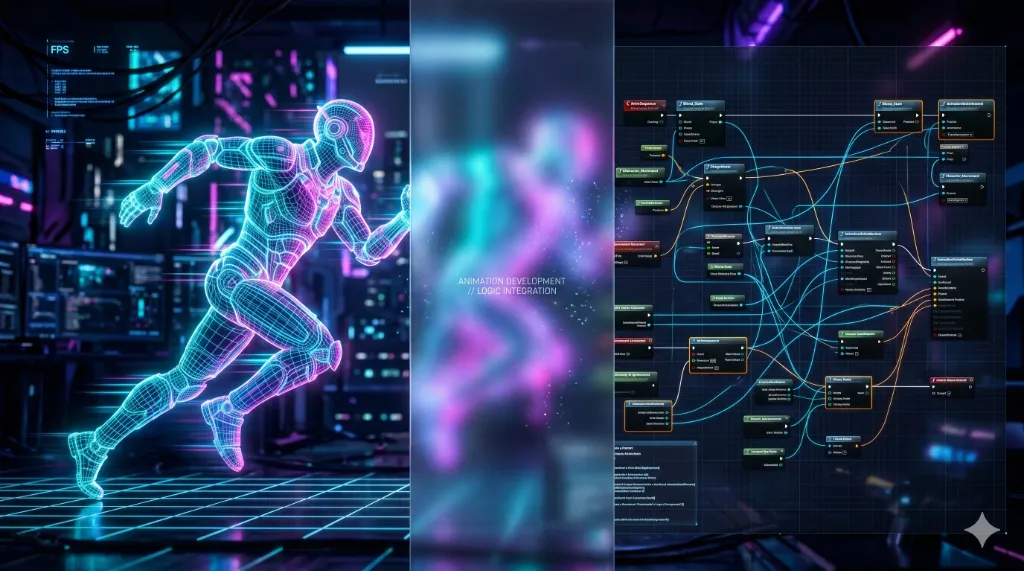
- Animation & Rigging: Maya's HumanIK, matrix-based constraints, and motion-matching tools offer unmatched performance with complex rigs containing thousands of deformers. Blender's Rigify and Auto-Rig Pro provide rapid rigging solutions for indie developers.
- Procedural Modeling: Blender dominates procedural modeling and environment scattering through Geometry Nodes. Maya relies on Bifrost for procedural workflows and complex FX simulation.
- Rendering Engines: Maya utilizes Arnold Renderer for uncompromised ray-traced realism. Blender utilizes Cycles for offline rendering and Eevee Next for real-time viewport feedback.
- USD & Pipeline Interoperability: Maya offers industry-leading OpenUSD support for pipeline asset streaming across Houdini, Nuke, and Unreal Engine 5.
Major feature film studios in Bangalore (such as Technicolor, DNEG, PhantomFX, and MPC) almost exclusively require Maya proficiency for 3D character animation and creature rigging job roles. Conversely, game studios, architectural visualization firms, and AR/VR startups actively hire Blender artists due to rapid asset creation speeds.
Rather than forcing students to choose one tool, MAAC Jayanagar's flagship AD3D EDGE Plus and AD3D EDGE Neo programs cover both Autodesk Maya and Blender. Students master Maya for feature-film character animation and Blender for high-speed procedural modeling and Unreal Engine asset pipelines.
Master Studio-Standard 3D in Autodesk Maya & Blender
Learn character animation, Arnold rendering, and ZBrush sculpting in AD3D EDGE Plus at MAAC Jayanagar.
Get 3D Animation Course Details →The Physics of Performance: Weight, Balance & Biomechanics
Human locomotion and character acting are governed by complex biomechanical physics. When a character walks, runs, or expresses emotion, every joint, muscle, and center of gravity shift must align with the character's internal thoughts and external physical resistance. Animators spend years studying live-action reference, body mechanics, and acting techniques to bring digital characters to life. Generative AI video generators lack physical weight understanding, producing floaty movement that immediately breaks audience immersion.
Core Animation Software Stack & Pipeline Mastery
- Autodesk Maya: The undisputed global standard for 3D character rigging, keyframe animation, and muscle deformation
- Blender: Open-source 3D suite for rapid previz, character layout, and Grease Pencil hybrid 2D/3D animation
- ZBrush: High-definition digital sculpting for character concept design and blendshape creation
- Unreal Engine 5 Control Rig: Real-time character animation, virtual production, and interactive cinematic performance
- Toon Boom Harmony: Professional 2D character animation and cut-out rigging for broadcast series
AD3D EDGE Plus — Advanced 3D Animation
Comprehensive career program with hands-on studio showreel production and placement support at MAAC Jayanagar, Bengaluru.
2026 Industry Hiring Trends & Salary Benchmark in India
With the global explosion of OTT streaming platforms, animated feature films, and AAA game production, trained 3D Animators enjoy immense job security. Salaries in India start at ₹4 LPA to ₹6 LPA for junior animators, scaling up to ₹15 LPA to ₹30+ LPA for senior character animators and animation directors. Artists who understand performance acting and narrative pacing remain the most sought-after talent in the industry.
1. 2026 Industry Landscape & Studio Hiring Requirements
The media, entertainment, and digital technology sectors across India and global markets are undergoing an extraordinary transformation in 2026. As streaming giants like Netflix, Amazon Prime Video, Disney+ Hotstar, and Apple TV+ increase their investments in Indian original content, studio requirements for high-end digital artists have evolved dramatically. Studios no longer look for entry-level technicians who merely press buttons in software interfaces. Today's animation studios, visual effects facilities, and game development houses demand creative problem solvers who possess deep artistic fundamentals—including composition, color theory, physical weight mechanics, lighting contrast, and visual storytelling.
According to the latest 2026 AVGC-XR (Animation, Visual Effects, Gaming, Comics and Extended Reality) Industry Benchmark Report, the Indian creative economy is growing at a compound annual growth rate (CAGR) of 18.5%. Cities like Bengaluru, Mumbai, Hyderabad, and Pune have solidified their position as global production hubs for Hollywood blockbusters, AAA video game titles, and international commercial broadcasts. For aspiring artists entering the industry in 2026, gaining comprehensive production training that bridges traditional artistic discipline with cutting-edge digital pipelines is the single most critical factor determining career success.
2. Production Pipelines, Software Tools & Workflow Masterclass
Modern production environments operate on highly integrated software pipelines where multi-disciplinary collaboration is essential. Whether working on a feature-length 3D animated movie, a visual-effects-heavy sci-fi series, or a real-time game engine environment, artists utilize an ecosystem of industry-standard tools:
- Autodesk Maya & 3ds Max: The gold standard for 3D character modeling, rigging, layout, lighting, and keyframe animation
- Foundry Nuke X: Industry-leading node-based compositing software used by 95% of Oscar-winning VFX studios worldwide
- Unreal Engine 5.4+: Real-time virtual production, real-time lighting (Lumen), geometry virtualization (Nanite), and game level design
- SideFX Houdini: Procedural volumetric simulation suite for realistic fire, smoke, water, ocean physics, and structural destruction
- Adobe Creative Cloud (Photoshop, Illustrator, After Effects, Premiere Pro): Core visual design, digital matte painting, kinetic motion graphics, and video editing
- ZBrush & Substance 3D Painter: High-definition digital sculpting, PBR material creation, and photorealistic asset texturing
Understanding how these software suites communicate via USD (Universal Scene Description) and multi-channel 32-bit EXR file formats allows artists to work fluidly across teams. At MAAC Jayanagar, students spend over 60% of their course duration inside dedicated studio production labs, simulating real-world client briefs and studio pipeline constraints under the guidance of seasoned industry mentors.
3. Salary Expectations, Career Growth & Studio Placements in India
A career in Animation, VFX, Game Design, or UI/UX product design offers some of the most lucrative and rewarding opportunities in the modern job market. Compensation packages in India scale rapidly based on portfolio quality, technical specialization, and artistic skill:
- Freshers / Junior Artists (0-2 Years): ₹3.8 Lakhs to ₹6.5 Lakhs per annum starting salary
- Mid-Level Specialist Artists (3-5 Years): ₹7.5 Lakhs to ₹14 Lakhs per annum
- Senior Leads, Supervisors & Technical Directors (5-8+ Years): ₹16 Lakhs to ₹35+ Lakhs per annum
- International Remote Freelance & Consultancies: $35 to $90 per hour depending on portfolio prestige
Top studio recruiters—including DNEG, Technicolor Creative Studios, Rockstar Games India, Ubisoft, PhantomFX, Red Chillies VFX, and Framestore—regularly conduct campus placements at MAAC Jayanagar. Students who build a strong, unique showreel showcasing individual artistic voice combined with technical mastery consistently secure immediate job offers upon course completion.
4. Why Artificial Intelligence Cannot Replace Human Creative Vision
While generative AI tools can automate repetitive prep tasks like basic rotoscoping or initial asset blocking, they lack human emotion, intent, and artistic taste. AI models operate by calculating statistical mathematical averages of pre-existing training data. Consequently, AI outputs frequently suffer from visual clichés, lack of shot-to-shot temporal continuity, and an inability to adapt to highly specific director feedback.
Filmmaking, game development, and design are fundamentally human collaborative endeavors. A director does not hire an artist to generate a generic computer average; they hire an artist for their unique human vulnerability, emotional subtext, and creative problem-solving. Artists who embrace AI as a productivity tool alongside core software pipelines are finishing projects faster and positioning themselves at the absolute top of the industry hierarchy.
Which 3D software is most preferred by feature film studios in 2026?
Autodesk Maya remains the undisputed industry standard at feature film and VFX studios globally in 2026. Studios like ILM, DNEG, Framestore, Weta FX, and Prime Focus use Maya for rigging, character animation, and dynamics pipelines. Its MASH toolset, robust plugin ecosystem, and compatibility with Houdini and Nuke make it essential for any animator targeting studio employment.
Is Blender being adopted by professional studios in India?
Yes. Blender is increasingly adopted in India for indie game development, architectural visualization, motion graphics, and concept art pipelines. Studios working on smaller-budget projects and startups are switching to Blender due to its zero cost and powerful Cycles/EEVEE render engines. However, for major VFX productions and AAA game studios, Maya and Houdini remain the primary tools.
Does MAAC Jayanagar teach both Maya and Blender?
Yes. MAAC Jayanagar teaches Autodesk Maya as the primary industry tool in all animation and VFX programs, supplemented by ZBrush, Houdini, and 3ds Max. Blender is covered as a supplementary skill within select modules. The curriculum prioritizes Maya proficiency since it directly aligns with hiring requirements at top Indian and international studios where MAAC alumni are placed.